
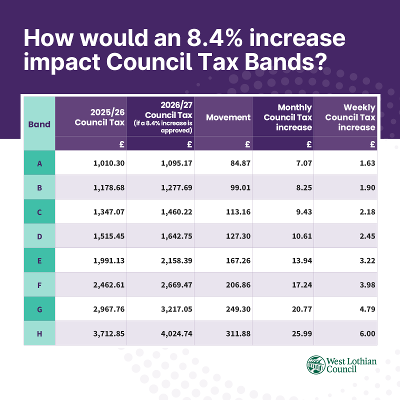
- Council Tax could increase by 8.4% in West Lothian from April 2026 if officer proposals are approved
- This level would allow the council to ring fence and target additional funding towards two specific areas: improving local roads and pothole repairs, and funding for adult and older people social care services (see below for details)
- West Lothian Council's Draft Revenue Budget is being presented next week, which includes setting Council Tax levels for the year ahead.
- If approved, Council Tax levels in West Lothian are still expected to remain below the Scottish average. West Lothian Council currently has the 9th lowest Council tax charges in Scotland (9th out of 32 councils)
- Council Tax is very important but it funds less than 20% of Council services. Grant funding - which the Scottish Government provides to the council - funds 80% of council services. Grant funding is not sufficient to fund all local services and keep pace with rising costs and increasing demand for council services
- Therefore, the income generated via Council Tax is needed to ensure the council can protect and improve services. Without an increase in Council tax, there would be significantly less funding for local services
Where will the additional Council Tax be spent?
Generally, all income raised via Council Tax is spread across all areas of council services * and supports the full range of essential local services that residents rely on every day — including education,waste and recycling, sstreet lighting,and many other services.
In addition to this broad support, this increase would also allow the council to target nearly £4million of additional funding towards two specific areas:
1. Funding adult and older people social care services
More vulnerable adults and older people need care and support and an increasing number of people need more complex packages of care and for longer. The cost of providing social care is also increasing.
West Lothian faces one of the fastest‑growing older populations in Scotland. This is creating unprecedented demand for social care packages, home care, residential care and support for adults with complex needs.
The additional Council Tax income will help avoid some of the most detrimental savings which will be considered by the Integration Joint Board (IJB).
2. Improving local roads and repairing potholes
£2 million in total over the next two years will be specifically targeted towards pothole repairs and road defects. This targeted investment will focus on tackling the current backlog of potholes and improving road surfaces across communities.
What would an 8.4% increase mean?
Band D Council Tax in West Lothian would be £1,642.75. An increase of:
- £127.30 per year
- £2.45 per week
However, the vast majority of Council Tax payers (62%) will pay less than this with average weekly increases from £1.63 to £2.18 (Bands A to C).
It is estimated that even with an increase of 8.4% in West Lothian that Council Tax rates will remain below the Scottish average.
The WL2028 Your Council Your Say consultation provided local residents, staff and partners with an opportunity to shape the council's budget, priorities and budget savings across various phases. 52% of respondents supported an increase in Council tax if all funding raised was spent on key services?
Notes:
*Generally, all income raised via Council Tax is spread across all areas of council services, with the exception of council housing (which is funded separately).
*The additional funding will be provided to the Integration Joint Board who are responsible for agreeing their own budget. The West Lothian Integration Joint Board (IJB) has responsibility for planning most health and social care services for adults in West Lothian.


